
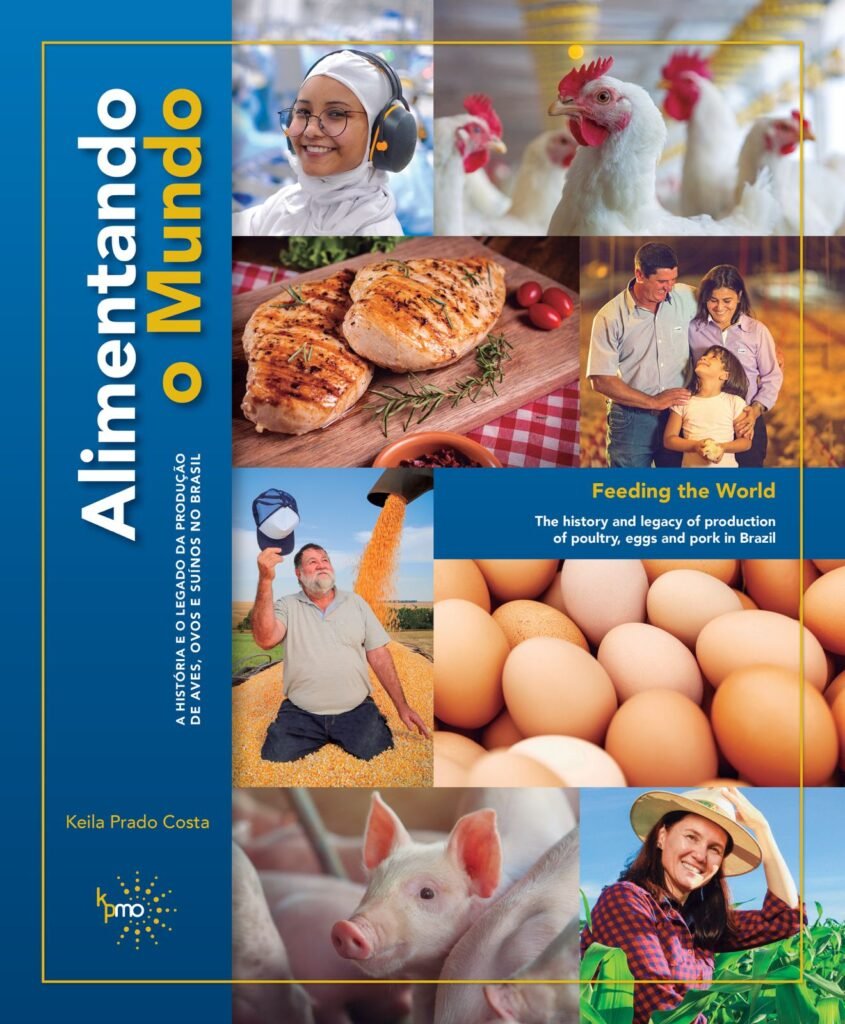
The book Feeding the World reveals in detail how Brazil moved from being a food importer to a global powerhouse, thanks to perseverance, innovation and the work of many people.
With a comprehensive approach to the historical trajectory of one of the most relevant segments of Brazilian agribusiness, Feeding the World: The History and Legacy of Poultry, Egg and Swine Production in Brazil features more than 50 interviews highlighting how women and men overcame adversity to transform Brazil into a global leader in animal protein production. Published by KPMO Publishing and written by Keila Prado Costa (USP), the book is supported by major institutions such as ABPA, Embrapa, FACTA, Alanac and Sindirações.
Conceived and presented by Osvaldo Penha Ciasulli, son of Oswaldo Gessulli, one of the founders of the first magazine focused on rural life, Chácaras e Quintais (1909), the book delivers to readers the history of poultry and swine production in Brazil. These sectors began modestly, with rudimentary production methods, but through hard work and advances in genetics, equipment, animal health and nutrition, they rose to become major global players.
The narrative shows how companies and cooperatives pioneered the transformation and development of the entire animal protein chain, from production to consumption, bringing a new perception to Brazilian society regarding the modernization process. It also explains how Brazil reached a benchmark position in food safety, one of the greatest challenges faced by global leaders today.
One of the key factors behind Brazil’s leadership in food safety was the adoption of the integration model, which enabled the country to sustainably and significantly develop poultry and swine production on small family farms linked to agribusiness companies. This model considerably reduced the impacts of rural exodus that occurred between the 1970s and 1990s and allowed producers and their families to achieve better living and income conditions. Today, many examples of the reverse movement can be observed, with people returning to the countryside.
The stories of these small producers reflect the dedication and success of national food production. Together with companies and cooperatives, they strengthened the market and generated wealth, proving that agribusiness is about dreaming, achieving, overcoming obstacles, building bonds, leaving paradigms for future generations, ensuring sustainability and reinforcing a love for the land. Each producer mentioned in the book found unique ways to face challenges and turn difficulties into opportunities, whether in poultry, swine production or other agribusiness activities.
“Feeding the World: The History and Legacy of Poultry, Egg, and Pork Production in Brazil” will be launched on August 7th, during the largest event for production chains in Brazil, SIAVS 2024, which will take place at the Anhembi District in São Paulo. The book will be available in all bookstores and on the KPMO Publishing House website.
“As these families build their history in the countryside, they not only secure their livelihoods but also shape the rural landscape of the future, a future in which the union of tradition and innovation, individual and collective knowledge, passion and faith consolidates Brazilian agribusiness as a vital force for the economy and a source of pride for all involved.” Feeding the World, page 227
“Brazil today has the best poultry industry in the world and we basically export quality and animal health with sustainability. Producing poultry meat, pork and eggs is a national asset, greater than oil and minerals that will one day run out. In addition, poultry, pork and egg production generates income for producers, makes small farms economically viable and brings foreign exchange through exports, while also driving a massive parallel supply chain such as transportation, equipment, refrigeration and other sectors.” Prof. Dr. Ariel Mendes (Unesp/FACTA
Technical Details “Feeding the world: the history and legacy of poultry, egg and pork production in Brazil”
Author: Keila Prado Costa
Pages: 280
Format: 23.0 x 28.0 cm
Price: BRL 145.00
Printed edition ISBN: 978-65-86913-20-0